Cosmetic
Platelet-rich plasma and fibrin use growth factors from your own blood to improve skin quality, reduce dark circles, and enhance periocular treatments.
Medically reviewed by Jon Caster, MDOculoplastic SurgeonLast updated June 2026
The delicate skin around the eyes is often the first area to show fatigue, discoloration, and the fine textural changes of aging. Increasingly, patients are searching for natural, minimally invasive ways to refresh this region without surgery or synthetic materials. Platelet-rich plasma (PRP) and its newer relative, platelet-rich fibrin (PRF), have emerged as popular options because they harness healing factors from your own blood. When performed thoughtfully — particularly by a physician who understands the intricate anatomy of the eyelids and orbit — these treatments can improve skin quality, soften under-eye dark circles, and enhance the results of other rejuvenation procedures.
This page explains what PRP and PRF actually are, how their growth factors work biologically, where they help most around the eyes, and — importantly — where the evidence is strong and where it remains preliminary. As oculoplastic surgeons, we believe patients deserve an honest, anatomically informed discussion rather than the marketing enthusiasm often found in non-medical settings.
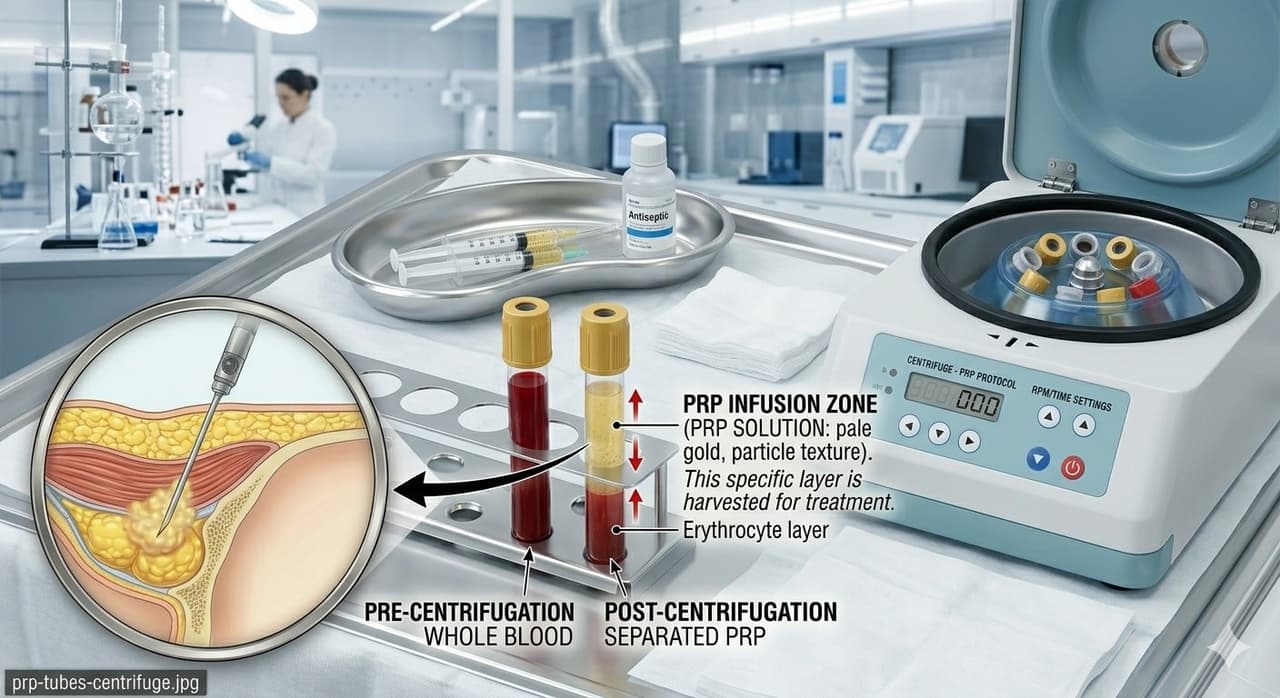
Both PRP and PRF begin the same way: a small sample of your blood is drawn and placed in a centrifuge, which separates the components by density. The goal is to concentrate platelets — the tiny cell fragments that release healing growth factors — and re-inject or apply them to tissue that needs regeneration. The differences lie in how the blood is processed.
PRP (platelet-rich plasma) is the first-generation product. Blood is drawn into a tube containing an anticoagulant (to prevent clotting), then spun at a relatively high speed. This produces a liquid plasma rich in platelets that can be injected or applied topically. Because it stays liquid, PRP delivers a rapid burst of growth factors.
PRF (platelet-rich fibrin) is considered a second-generation, more “natural” product. It is spun at a slower speed and, critically, uses no anticoagulant. Without anticoagulant, the blood begins to form a soft fibrin clot as it spins. This fibrin scaffold traps platelets and white blood cells, and it releases growth factors gradually over about a week rather than all at once. PRF is typically richer in leukocytes and fibrin, though relative platelet content varies by preparation protocol.
In periocular practice, liquid PRF or an intermediate form is often preferred under the eyes because its slower, sustained release may support gradual collagen remodeling, while the fibrin matrix can add subtle volume. Dr. Caster will select the preparation that best matches your goals — part of the periocular rejuvenation toolkit.
The therapeutic power of PRP and PRF lies in the growth factors stored within platelet granules. When platelets are concentrated and activated, they release a cascade of signaling proteins that orchestrate the body’s natural repair processes. The key players relevant to skin rejuvenation include:
Together, these factors nudge the skin toward a regenerative state: fibroblasts lay down new collagen and elastin, dermal thickness gradually increases, and microvascular quality may improve. Over weeks to months, patients often notice firmer, better-hydrated, more resilient skin. Some studies also suggest an effect on melanin regulation — potentially helping the pigmentary component of dark circles — though this mechanism is less well established than the collagen-building effects.
Because the material comes entirely from your own body, the risk of allergic reaction or rejection is very low, which is one of PRP/PRF’s appealing features (though additives used in processing and injection-related complications can still occur).
The under-eye region is uniquely suited to regenerative approaches because the skin here is the thinnest on the body and shows early signs of thinning, discoloration, and crepiness.
Dark circles have several causes, and PRP/PRF addresses some better than others. The vascular component — the bluish-purple tint from visible vessels and stagnant blood beneath thin skin — may respond as growth factors thicken the overlying dermis and improve microcirculation, making the underlying color less apparent. A hollow (structural) component from volume loss responds better to fillers or fat grafting. Purely pigmentary dark circles may improve modestly but often need adjunctive treatment. A careful evaluation determines which mechanism dominates.
For patients with fine lines, crepey texture, or dull, thin skin who are not ready for surgery or laser resurfacing, PRP/PRF offers a gentle route to gradual improvement in firmness and radiance.
PRP and PRF are frequently used to enhance other procedures rather than as standalone therapies — boosting healing and collagen response when combined with RF microneedling or fat grafting.
A typical periocular PRP/PRF session is straightforward and completed in the office in about 45–60 minutes:
Important: Under-eye injections carry a small but serious risk of bruising and, rarely, inadvertent intravascular injection, which can cause skin necrosis or, very rarely, vision loss. Expect visible bruising for several days to two weeks — schedule around social events. Avoid blood thinners, alcohol, and anti-inflammatory medications beforehand when medically appropriate, and follow Dr. Caster’s guidance. PRP/PRF may not be appropriate for everyone — for example, in the setting of an active infection at the treatment site, certain bleeding or platelet disorders, or anticoagulation that cannot be safely paused — so a medical history review is part of the evaluation.
We believe in transparency about what PRP and PRF can and cannot do. The scientific literature supporting regenerative treatments for periocular skin is growing but less robust than the evidence behind established surgical and laser procedures.
What the evidence supports reasonably well:
Where the evidence is weaker or inconsistent:
If your primary concern is significant hollowing or festoons, a structural approach — such as fillers, fat grafting, or surgery — will likely serve you better than PRP alone. PRP/PRF works best as one component of a customized skin rejuvenation plan.
Because PRP and PRF stimulate a gradual biological response rather than adding volume directly, a series of treatments produces the best results. A typical periocular protocol involves:
| Phase | Typical Schedule |
|---|---|
| Initial series | 3–4 sessions spaced 4–6 weeks apart |
| Onset of visible change | Gradual over 4–12 weeks as collagen builds |
| Maintenance | 1–2 sessions per year |
Because the improvement accumulates, patience is essential. Most patients see the fullest benefit a few months after completing the initial series, when new collagen has matured.
PRP and PRF often deliver their greatest value as part of a layered treatment plan. Combining regenerative therapy with other modalities addresses multiple contributors to periocular aging simultaneously.
This is one of the most popular pairings. RF microneedling creates controlled micro-injuries and delivers radiofrequency heat to stimulate collagen; applying PRP/PRF into the resulting channels supplies concentrated growth factors exactly where the healing response is activated. Many patients report improved texture and reduced downtime with the combination.
When PRP is mixed with harvested fat during facial fat grafting, the growth factors may improve graft survival and skin-quality outcomes over the treated area — combining structural volume with regenerative support.
Following laser resurfacing, topical PRP/PRF may accelerate epidermal recovery and reduce redness, smoothing the healing process.
PRP and PRF are widely offered in medspas and non-medical settings, but the periocular region is not a place for casual treatment. The area is only millimeters from the eye itself and is densely populated with critical structures: the angular and supratrochlear vessels, the orbital septum, the lacrimal drainage system, and the levator mechanism that lifts the eyelid. An injection placed carelessly here can cause serious complications — from prolonged bruising to, in rare instances, intravascular injection causing tissue necrosis or vision loss.
Oculoplastic surgeons are ophthalmologists with additional ASOPRS fellowship training focused entirely on the eyelids, tear ducts, and orbit. This means we approach periocular PRP differently:
Important: Beware of clinics that promise dramatic, immediate results from PRP alone or apply it near the eyes without a physician evaluation. The safest and most effective periocular rejuvenation begins with a thorough diagnosis by a specialist who understands the anatomy.
If you are considering PRP or PRF to refresh the skin around your eyes, soften dark circles, or enhance another rejuvenation procedure, the most important first step is an evaluation with a qualified specialist who can identify the true source of your concerns and design a safe, realistic plan.
Schedule a consultation with Jon Caster, MD to learn if this procedure is right for you.