Cosmetic
A complete week-by-week guide to blepharoplasty recovery: managing swelling and bruising, activity restrictions, and when to call your surgeon.
Medically reviewed by Jon Caster, MDOculoplastic SurgeonLast updated June 2026
Deciding to have eyelid surgery is only the beginning of the journey. Once the decision is made, most patients turn their attention to a single question: “What will recovery actually be like?” Understanding the healing process week by week — what is normal, what is not, and when you can return to the activities you love — is one of the most powerful ways to reduce anxiety and achieve a smooth result. This guide walks you through the entire blepharoplasty recovery timeline from the perspective of an oculoplastic surgeon, so you know exactly what to expect from the recovery room through the final refinement of your result.
Blepharoplasty is a remarkably well-tolerated operation. The eyelid skin is thin and its blood supply is rich, which means it heals quickly and hides scars beautifully. But that same delicacy also means the eyelids swell and bruise easily in the early days. The good news is that nearly every part of the early recovery is temporary and predictable. Knowing the pattern in advance turns those first alarming-looking days into a normal, expected part of the process.

The first 72 hours are the most active phase of healing and the period where your habits make the biggest difference. Immediately after surgery your eyelids will feel tight, mildly sore, and slightly numb along the incision lines. Most patients describe the discomfort as pressure or a dull ache rather than sharp pain — and it is typically well controlled with acetaminophen (Tylenol®) alone. Prescription narcotics are rarely needed.
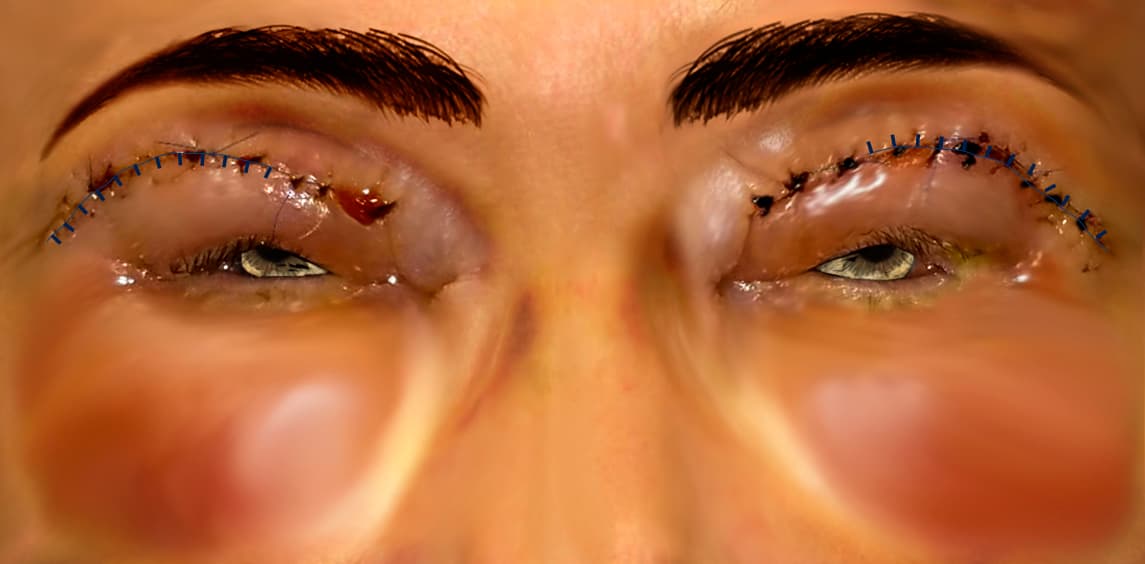
Swelling peaks around days 2 to 3, not on the day of surgery. This surprises many patients, who feel fine leaving the surgical center and then look puffier the next morning. Bruising may appear as pink, purple, or yellow discoloration that can migrate downward with gravity onto the cheek. Both are completely expected and reflect normal tissue response, not a complication.
Fill your prescriptions and set up your recovery station before surgery: gel packs in the freezer, drops and ointment on the nightstand, and an extra pillow ready. Planning ahead means you can focus on rest. Learn more about the procedure itself on our Blepharoplasty page.
Mild blurry vision from ointment, a gritty or scratchy sensation, and light sensitivity are all normal during this window. Sunglasses are helpful both for comfort and for shielding the healing skin from UV exposure.
By the end of the first week, the most dramatic swelling and bruising have usually begun to settle, though you will still look noticeably “operated on.” This is the week when most sutures are removed and when patients transition from active swelling control to simple protection and patience.
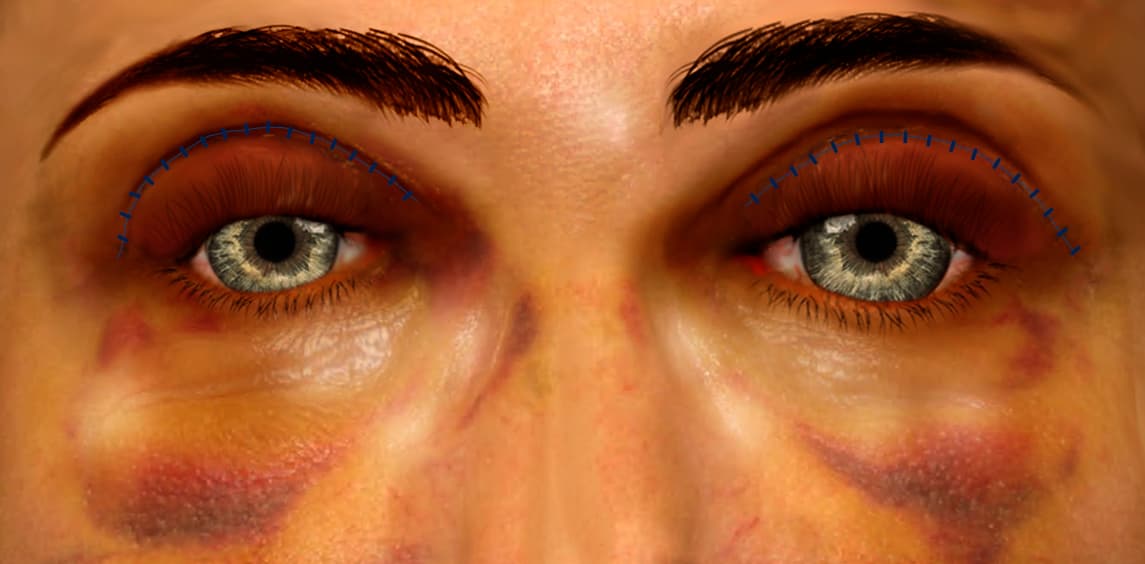
Most external eyelid sutures are removed between days 5 and 7. Upper eyelid incisions heal so predictably that suture removal is quick and nearly painless. Some surgeons use dissolvable sutures that require no removal at all. Lower eyelid incisions placed inside the eyelid (the transconjunctival approach) have no external sutures to remove.
Important: A small amount of pink-tinged tearing is normal, but active bleeding, rapidly increasing swelling on one side, or worsening pain after the third day is not. See the warning signs section below and call Dr. Caster if these occur.
Many people take the first week off from work and social activities. You can read, watch television, and walk gently around the house, but you should avoid straining, bending, and heavy lifting during this time.
This is the phase where life gets recognizably back to normal. By the start of week two, most bruising has resolved or can be easily covered with makeup, and the incisions have sealed. Residual swelling remains — especially in the mornings and along the lower lids — but it is far less noticeable to others than it feels to you.
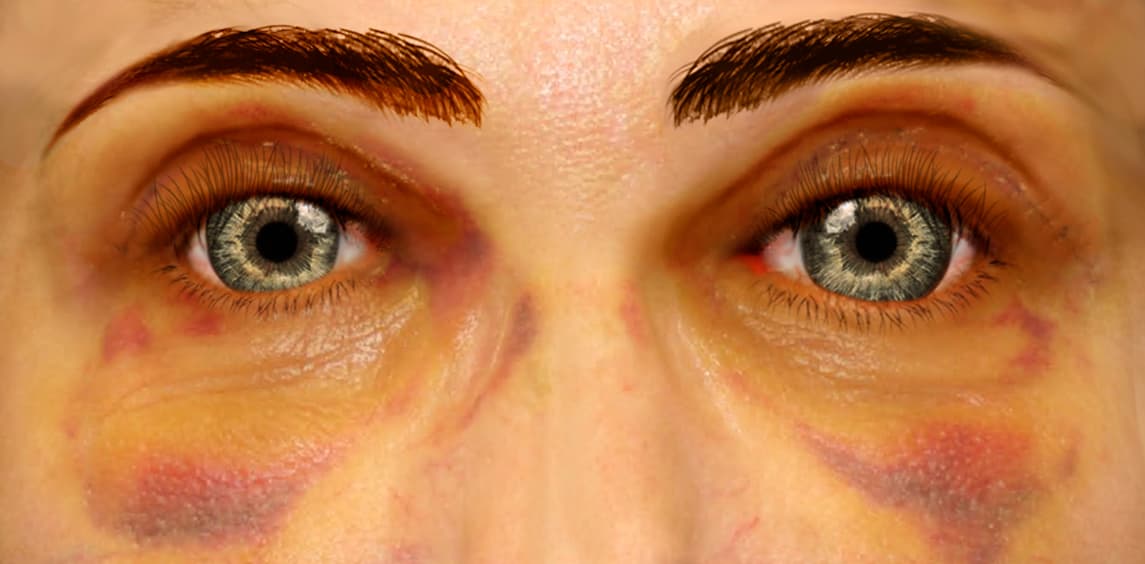
Patients with desk or remote jobs often return to work between days 7 and 10, once sutures are out and bruising can be concealed. Those in physically demanding roles — construction, nursing, athletics — may need two weeks or more before resuming their full duties because of activity restrictions on lifting and straining.
Eyelid makeup and concealer can usually be applied once the incisions are fully sealed and sutures are removed, typically around day 7 to 10. Mineral-based concealers with a green or yellow color-corrector are excellent for neutralizing residual bruise tones. Avoid tugging on the delicate healing skin when removing makeup.
Fine, subtle swelling can persist for several weeks, giving the eyelids a slightly “full” look and occasionally a temporary sense that the eyes feel different when blinking. This is a normal part of tissue remodeling and continues to improve steadily.
While you will look presentable within two weeks, the final refined result takes longer to reveal itself. Deep tissue swelling resolves gradually over one to three months, and the incision scars mature over three to six months — and sometimes up to a year.
Eyelid incisions typically heal to nearly invisible lines hidden in the natural crease of the upper lid or just beneath the lashes of the lower lid. In the first several weeks a scar may look pink or slightly raised; this is the normal proliferative phase. Over the following months it fades, flattens, and softens. Gentle scar massage and diligent sun protection accelerate this process.
If your surgery addressed drooping of the eyelid itself rather than excess skin, your recovery may follow a slightly different arc. Learn more about the distinctions on our Ptosis page.
| Time Period | What to Expect | Activity |
|---|---|---|
| Days 1–3 | Peak swelling and bruising; tightness; mild ache; use cold compresses, drops, ointment, head elevation | Rest; no bending or lifting |
| Days 4–7 | Swelling begins to ease; bruising turns yellow-green; sutures removed around day 5–7 | Light walking; gentle daily tasks |
| Week 2 | Most bruising resolved or coverable; incisions sealed; makeup permitted | Desk work; social activities |
| Weeks 3–4 | Residual morning puffiness; incisions may be pink; result looking natural | Resume light exercise; physical jobs |
| Months 1–3 | Deep swelling resolves; scars fading and flattening; near-final result | Full activity; strenuous exercise typically resumed around weeks 3 4 with surgeon approval |
| Months 3–12 | Complete scar maturation; final refined contour | No restrictions |
Activity limits exist for one primary reason: to prevent bleeding and excess swelling in the delicate healing tissues. Anything that raises blood pressure in the head — straining, bending, lifting, or vigorous exercise — can cause a bruise or, rarely, a more significant bleed. Following these restrictions protects both your comfort and your final result.
Ultraviolet light can cause long-lasting darkening (hyperpigmentation) of healing scars. Once incisions are sealed, apply a mineral sunscreen (zinc or titanium based) to the eyelid area and wear sunglasses and a hat outdoors for at least the first several months. This single habit makes a meaningful difference in how invisible your scars become.
Contact lens wearers should plan to use glasses for about two weeks. Screen use is fine as tolerated, but prolonged screen time reduces your blink rate and can worsen the temporary dryness common after surgery — take frequent breaks and use lubricating drops.
Serious complications after blepharoplasty are rare, but knowing the red flags allows you to act quickly in the unlikely event one arises. The most important concern is an orbital hemorrhage — bleeding behind the eye — which is a genuine emergency because it can threaten vision.
Important — seek immediate care if you experience: sudden or worsening vision loss or double vision; severe, escalating pain that is not relieved by medication; rapidly increasing swelling or firmness especially on one side; a tense, bulging eye; increasing redness, warmth, or pus suggesting infection; or fever. Call Dr. Caster or go to the nearest emergency department without delay.
Less urgent but still worth a call to Dr. Caster’s office: incisions that separate or open (note: bleeding that soaks through dressings warrants a prompt, same-day call to Dr. Caster, and immediate care if accompanied by increasing pressure, a bulging eye, or any vision change), or any symptom that simply concerns you. Your surgical team would always rather answer a question early than have you worry alone. Reassurance is part of good care.
Recovery differs meaningfully depending on which eyelids are treated. Understanding the distinction helps you plan your time off and set realistic expectations.
Lower eyelid surgery tends to produce more visible bruising because the discoloration migrates down onto the cheek, and the swelling can take slightly longer to fully settle. Upper eyelid surgery, by contrast, is one of the most forgiving procedures in facial surgery — the crease incision heals into a nearly invisible line and downtime is comparatively short.
Many patients combine blepharoplasty with a brow lift, ptosis repair, or laser skin resurfacing in a single session. Combining procedures is efficient — one anesthetic, one recovery — but it does extend the timeline and typically increases early swelling and bruising.
When procedures are combined, follow the recovery guidance for whichever component has the longest timeline, and lean heavily on head elevation and cold compresses in the first few days.
Every patient heals a little differently. Dr. Caster’s specific instructions always take precedence over any general guide — including this one.
A smooth recovery begins long before surgery — with a surgeon who takes the time to explain what to expect, provides clear written instructions, and remains available to answer your questions during healing. ASOPRS fellowship-trained oculoplastic surgeons specialize in the eyelids and surrounding structures, and that focused training brings deep familiarity with eyelid anatomy, incision placement, and postoperative care.
Schedule a consultation with Jon Caster, MD to learn if this procedure is right for you.